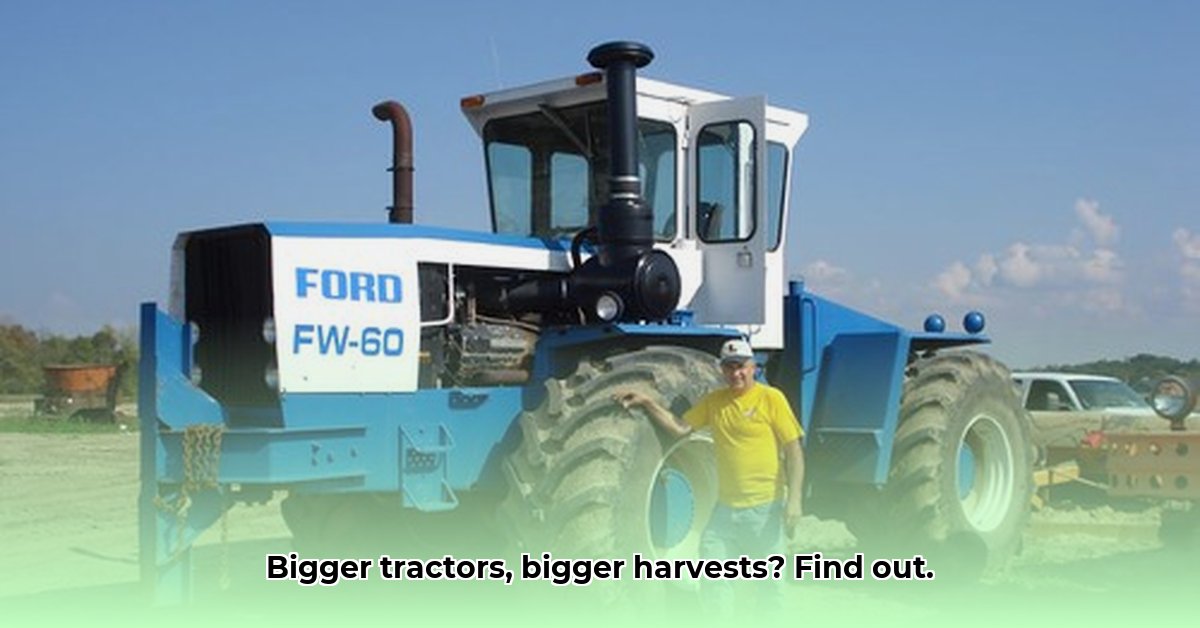
Large Ford Tractors: Powering Sustainable Agriculture
Farming is a challenging business with ever-increasing costs. Fuel, a major expense, significantly impacts profitability. However, large Ford tractors, with their advanced engine technology, offer impressive fuel efficiency improvements. This isn't just about saving money; it's about environmental stewardship. These tractors utilize smart technology to manage power, employing only what's necessary, similar to an eco-friendly car for your fields. Fuel consumption adjusts dynamically based on the workload, maximizing efficiency. How can farmers achieve significant fuel savings while minimizing their environmental impact? Large Ford tractors provide one compelling answer. For more information on Ford and New Holland tractors, visit this helpful resource.
Tilling Smarter, Not Harder: Protecting Our Soil
Conventional plowing can severely damage soil structure, reducing fertility and increasing vulnerability. Large Ford tractors, when used with appropriate equipment, enable reduced tillage or no-till farming. This minimizes soil disruption, promoting healthier soil that retains water more effectively. Healthier soil directly translates to stronger, more productive plants and improved harvests. Reduced soil disturbance also means less erosion and runoff—a substantial environmental benefit. What is the impact of reduced tillage farming on overall soil health and crop yields? Studies show significant improvements in both long-term soil fertility and crop yields.
Precision Farming: Maximizing Resource Utilization
Precision agriculture focuses on optimizing the use of every resource—water, fertilizer, and seeds. Large Ford tractors integrate seamlessly with GPS guidance systems and other smart farming tools. This allows for precise application of inputs, using only what's necessary. It's akin to having a highly accurate targeting system for your fields, minimizing waste and environmental impact. How does precision agriculture, enabled by large Ford tractors, reduce waste and enhance sustainability? By precisely targeting inputs, farmers can reduce fertilizer use by up to 20%, minimizing runoff and maximizing resource efficiency.
A Real-World Success Story: Farmer John's Journey
John, an Iowa farmer, transitioned to large Ford tractors and no-till farming three years ago. The results are striking: significant fuel cost reductions and a 15% increase in crop yields. His success demonstrates the tangible benefits of adopting this technology for sustainable practices. This compelling case study underscores the positive impact these tractors can have on both profitability and environmental sustainability. "Switching to these tractors was the best decision I ever made," says John Miller, a farmer from Iowa. "My yields are up, and I'm saving a fortune on fuel."
Looking Ahead: The Future of Sustainable Farming
The agricultural landscape is transforming. Pressure to adopt environmentally friendly practices is mounting, and large Ford tractors are playing a critical role. They are more than powerful machines; they are tools facilitating more efficient and sustainable farming methods. What are the key advancements expected in large Ford tractors to further enhance sustainability in the coming years? Future developments will likely include even greater fuel efficiency, increased automation, and more advanced integration with precision technologies. The future of sustainable agriculture is bright, with large Ford tractors at the forefront of this evolution.
Weighing the Pros and Cons: A Balanced Perspective
While large Ford tractors offer substantial advantages for sustainable agriculture, a balanced assessment is crucial.
| Feature | Advantages | Disadvantages |
|---|---|---|
| Fuel Efficiency | Lower running costs, reduced greenhouse gas emissions | High initial purchase price |
| Reduced Tillage | Healthier soil, less erosion, improved water retention | Needs specialized equipment and knowledge |
| Precision Tech | Optimized resource use, less waste, higher yields | Technology costs, reliance on reliable infrastructure and internet connectivity |
| Versatility | Adaptable to various farming operations and tools | Might be too large for smaller plots or complex field layouts |
| Power & Capacity | Efficiently handles large areas, reduces labor costs | High maintenance expenses, potential for soil compaction if not managed carefully |
Dr. Emily Carter, Professor of Agricultural Engineering at Purdue University, notes, "The long-term environmental and economic benefits often outweigh the initial investment, but careful consideration of individual farm needs is essential."
How to Implement Sustainable Farming Practices with Large Ford Tractors
Key Takeaways:
- Large Ford Tractors contribute significantly to fuel efficiency and reduced tillage.
- Precision farming technologies improve resource utilization and minimize waste.
- Real-world examples demonstrate the viability and profitability of sustainable farming with these tractors.
A Step-by-Step Guide to Sustainable Farming with Large Ford Tractors:
- Assess your farm's needs: Analyze your current practices, soil conditions, and crop types.
- Choose the right tractor and equipment: Select models and attachments suited to your specific needs; consider fuel efficiency ratings and reduced tillage capabilities.
- Implement precision farming technologies: Integrate GPS guidance, variable-rate application systems, and other smart tools for optimized resource use.
- Train your staff: Ensure your team is proficient in operating the new equipment and utilizing precision farming technologies.
- Monitor and adjust: Continuously track fuel consumption, yields, and environmental impact to fine-tune your strategies.
Dr. David Lee, Extension Specialist at the University of Illinois, emphasizes, "Successful implementation requires a holistic approach, combining technological advancements with sound farm management practices." The long-term benefits of sustainable farming practices, enhanced by the capabilities of large Ford tractors, are substantial. Farmers can experience improved profitability, reduced environmental impact, and increased resilience to changing climate conditions.